Payment as a service
Seamless payments,
everywhere
Payment options for EV drivers
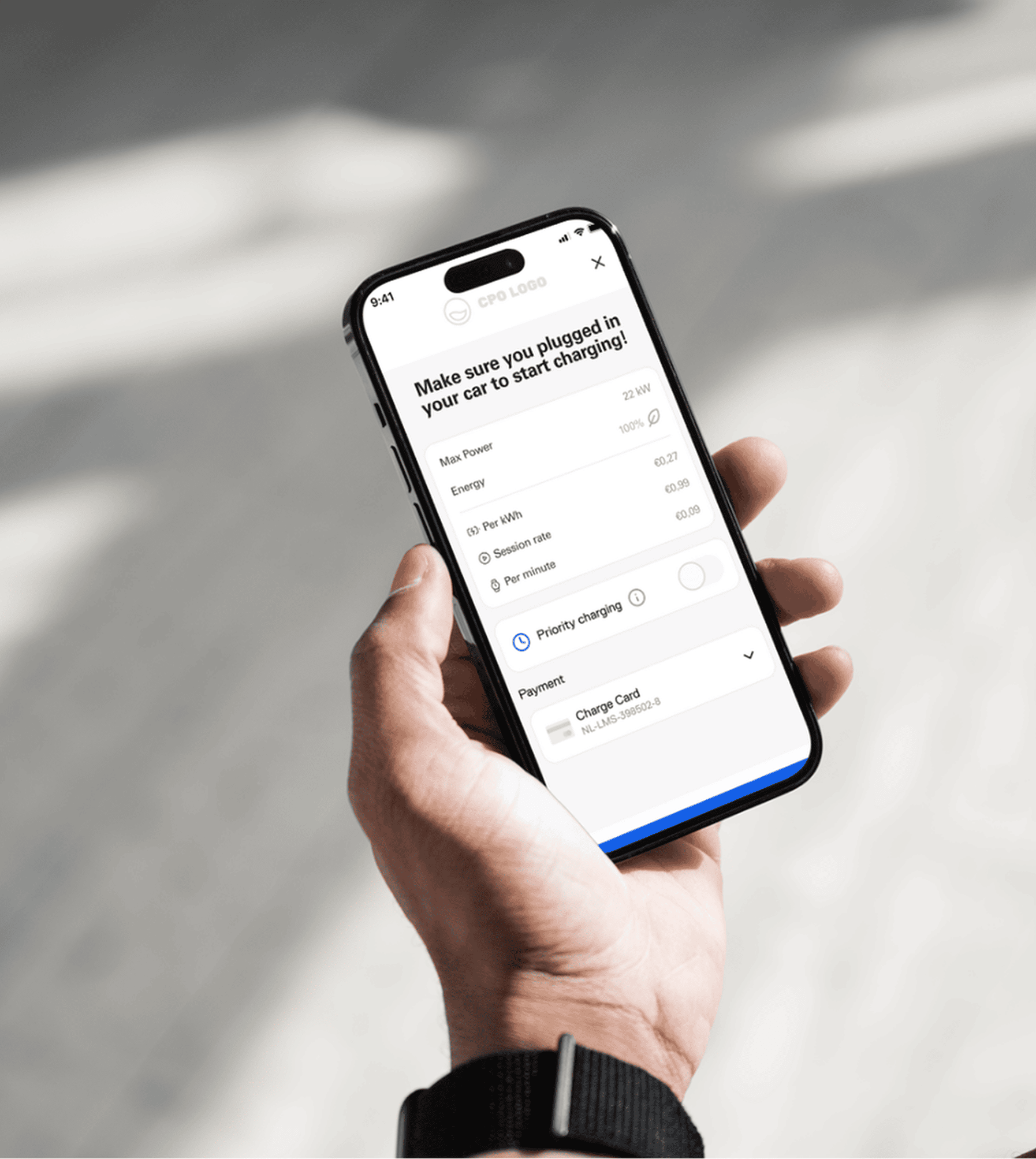
Enable all payment methods for your clients
No matter which payment method you want to offer as a CPO, we capture the charging data, enable the transaction, collect the funds, and settle payments — fully integrated, one contract, one point of contact.
RFID charge card
Pay with a physical charge card, including roaming support.
Charging app
Use a virtual token via app, with roaming compatibility.
Online payment
Pay through the app (registered or anonymous) using various online methods like credit/debit cards or local payment systems.
Credit/debit card at the charger
Tap and pay directly at the charger using Visa, Mastercard, Amex, Google Pay, or Apple Pay.
Complete your setup with powerful tools
Scale your financial operations with tools built for flexibility, control, and growth.
Station management
Make payment effortless. At any location, for every driver.
- Compatible with all standard methods
- Integrated with your billing stack
Card & station connectivity
Connect charge cards, stations, and roaming into one seamless system.
- Full interoperability
- Roaming-ready by default
Home reimbursement
 Providing tax-compliant, accurate payouts for every employee
- Eliminate manual administration for HR and finance
- Visibility of employee home charging costs
Billing as a Service
Billing, collection, and payout across all stakeholders.
- End-to-end revenue handling for CPOs & MSPs
- Full control over tariffs and margins
As part of Ecotap's ambition to build the best charging infrastructure in the world in the most sustainable and social way possible, it is important to find the right partners. Ecotap has been working with Last Mile Solutions for years to achieve this goal.Kees van Bergen | CEO, Ecotap
Case studies
Real-world impact for real businesses. Discover how Last Mile Solutions helped clients grow revenue and simplify financial operations.
Want to see how it works for your setup?
Let’s explore how Last Mile Solutions can support your business goals with smart monetisation tools and scalable financial workflows.
Frequently asked questions
Why is a payment terminal more than just a piece of hardware?
A payment terminal isn’t just a device on a charging station — it’s the front end of a complex financial ecosystem. Behind every tap or swipe, multiple financial parties must work together seamlessly: acquirers, payment service providers, and terminal manufacturers all play a role.
At Last Mile Solutions, we’ve established direct contracts and integrations with these players to deliver a complete, end-to-end solution. This includes not just transaction processing, but also automated VAT handling, correct invoicing, and proper settlement across borders — all in line with local tax regulations.
The result? A fully integrated system where charge point operators don’t need to worry about the complexity in the background. We ensure the entire payment flow — from tap to bank to back office — simply works.
Why is installing a payment terminal on charging stations so important right now?
The way EV drivers pay for charging is changing fast. More and more drivers just want to tap and go — using a debit card, credit card, or digital wallet — without dealing with apps, RFID cards, or accounts.
This shift is being driven in part by new European legislation: the Alternative Fuels Infrastructure Regulation (AFIR). Since April 2024, this regulation requires that all new public DC chargers with a capacity of 50 kW or more be equipped with a payment terminal. Existing chargers must comply by 2027. For many operators, the question is no longer if — but how fast.
At the same time, customer expectations are shifting. EV drivers are asking for simple, transparent payment experiences — without hidden fees or unclear pricing. Security also plays a role: traditional RFID systems are increasingly vulnerable to fraud, while card-based EMV payments are far more secure.
Finally, terminals also drive revenue. At locations where a terminal was added, we’ve seen a significant shift toward bank card usage and increased transaction volumes. Installing a terminal is no longer just about compliance — it’s what drivers want, and what makes business sense.